
Art above a sofa should span roughly 60-75% of the sofa’s width — the same furniture-relative convention used above a bed or dresser — with its bottom edge about 6-8 in (15-20 cm) above the top of the sofa’s backrest. That is a different target from the generic "hang everything at eye level" rule, and the two can genuinely contradict each other above a sofa. A common three-seater sofa runs roughly 75-87 in (190-220 cm) wide; this guide uses 84 in / 213.4 cm as the worked example. A loveseat usually runs 59-67 in (150-170 cm); its worked example is 63 in / 160 cm. Match whichever is closer to your own sofa, then read on for why "eye level" gets the height wrong here.
The 60-75% width rule
This 60-75% figure is a furniture-relative sizing convention, not a law of design: it treats the sofa — not the whole wall — as the frame of reference, the same way a desk sizes the art placed above it (see our guide to choosing art for a home office for that version of the rule). It stops applying in two situations: when the sofa sits against a much larger feature wall, where a wider arrangement can look intentional rather than undersized, and when you’re building a full arrangement of several small pieces rather than one anchor piece, where total footprint matters more than any single width. In the ordinary case — one sofa, one wall, a single piece or a small pair above it — 60-75% is the range to aim for. Below roughly 50% the piece tends to read as floating, disconnected from the furniture beneath it; above 75% it starts competing with the sofa’s own footprint, overlapping side tables or lamps at either end. The 60-75% band is simply the zone between those two failure modes.
Worked example: a three-seater sofa (213.4 cm)
Take the 84 in / 213.4 cm three-seater. The target width is 60-75% of that: 213.4 × 0.60 = 128.04 cm and 213.4 × 0.75 = 160.05 cm, so aim for about 128-160 cm (50-63 in) of combined art width.
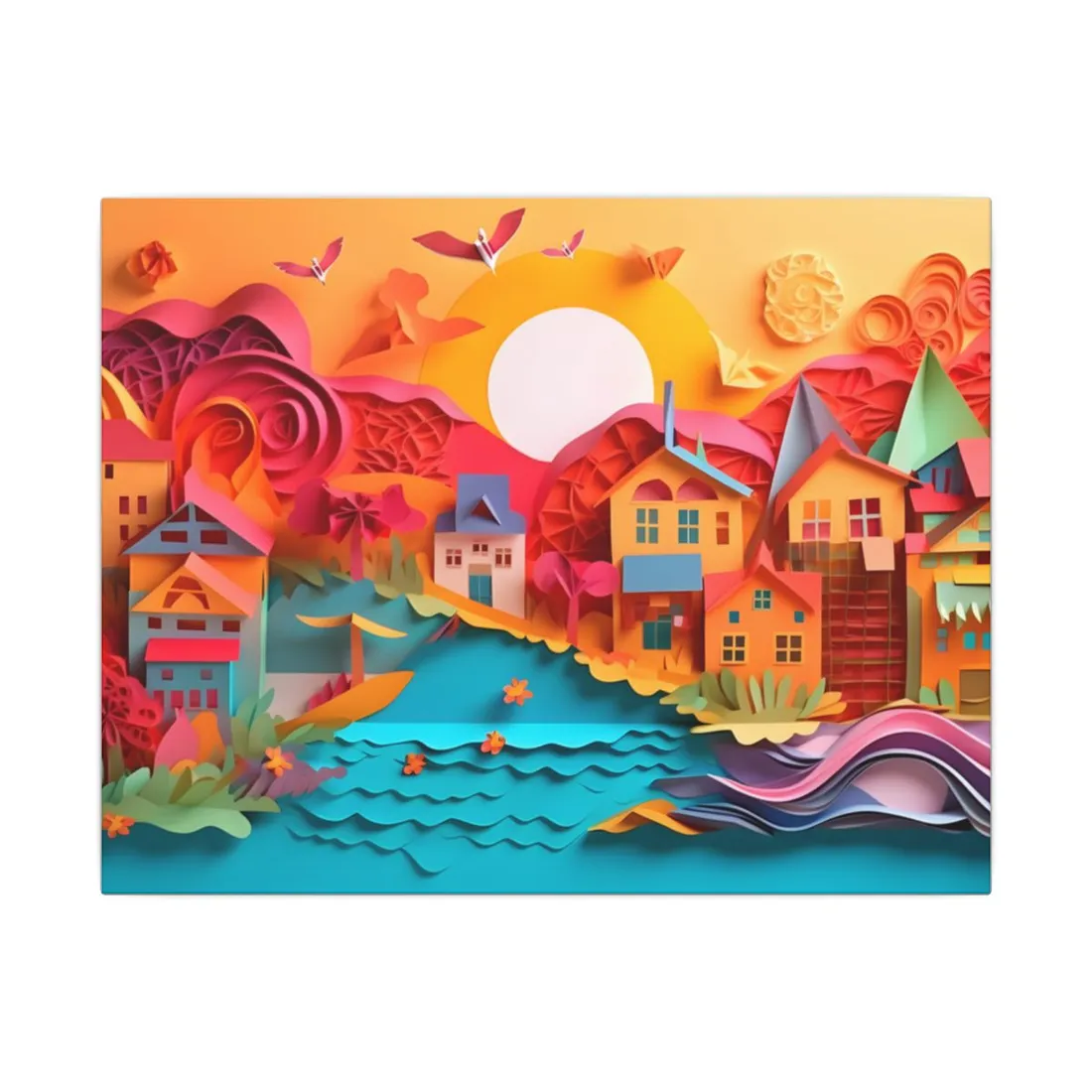
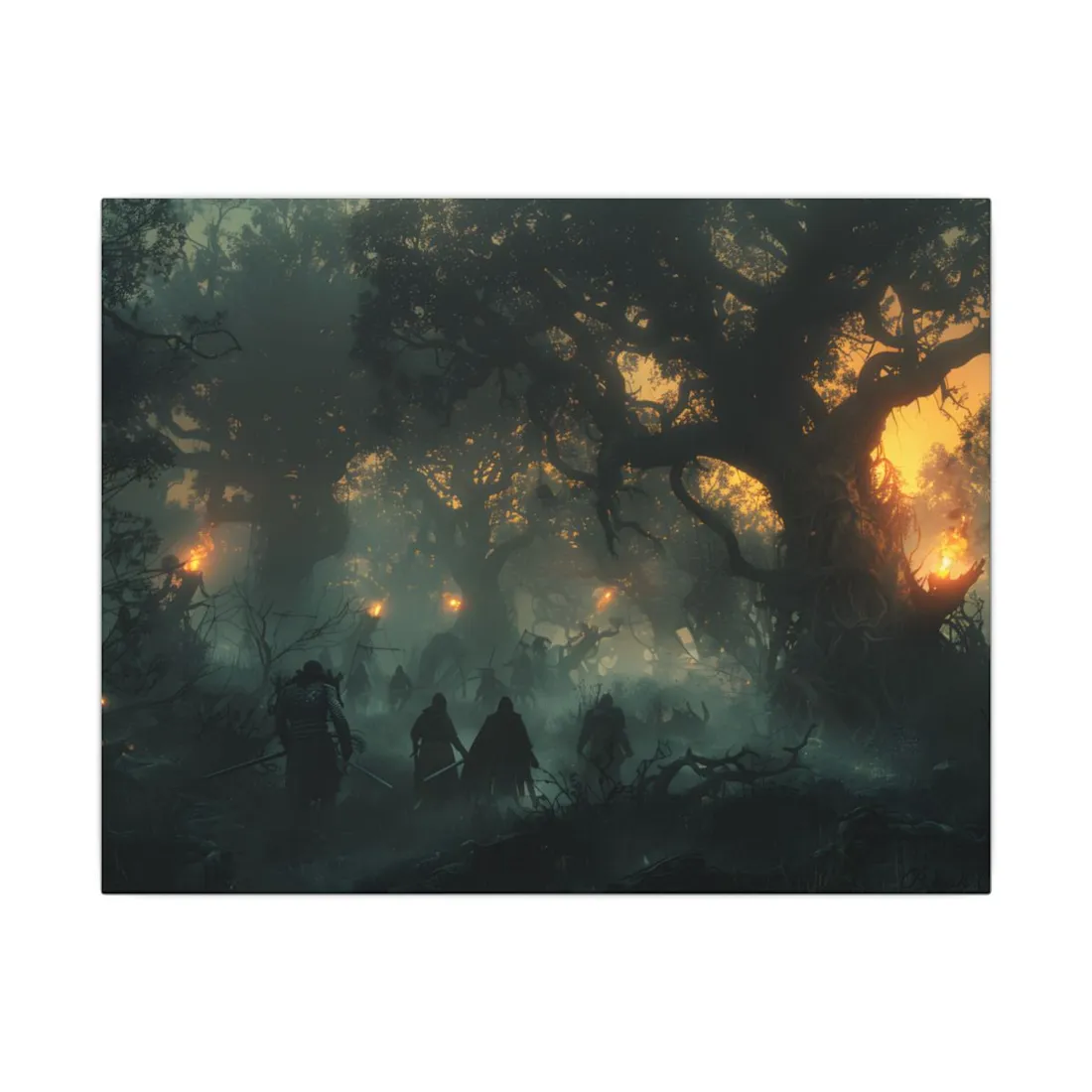
A 24 × 16 in horizontal canvas converts to 24 × 2.54 = 60.96 cm wide by 16 × 2.54 = 40.64 cm tall. Two of them side by side with a 10 cm gap between them come to (2 × 60.96) + 10 = 131.92 cm (51.9 in) total — and 131.92 ÷ 213.4 = 0.618, or 61.8% of the sofa’s width: inside the 60-75% range, near the lower end. On each side, that leaves (213.4 − 131.92) ÷ 2 = 40.74 cm of sofa visible beyond the canvases.
Two AI-generated canvases (AI-directed by Burak Basci) work for this pairing: Village Houses Along River Canvas Print and Armored Warriors in Misty Forest Canvas Print, both available in 24 × 16 in horizontal. They differ strongly in mood — a bright paper-cut riverside village and a dark misty forest — and they are two separate products, not a matching set sold as one, so check both product pages before ordering.
Height: why "eye level" gets this wrong above a sofa
The generic picture-hanging rule puts the centre of the art at 57-60 in (145-153 cm) from the floor — the standing eye-height convention meant for open wall space you view on your feet, such as a hallway or a console table. Above a sofa you view that wall mostly seated, so a furniture-relative rule applies instead: bottom edge = sofa-back height + 15-20 cm.
A typical sofa back stands 32-37 in (80-95 cm) off the floor; use 34 in / 86 cm as the middle value. Add the middle of the 15-20 cm gap range, 17.5 cm: 86 + 17.5 = 103.5 cm for the bottom edge. The canvas is 40.64 cm tall, so its centre sits at 103.5 + (40.64 ÷ 2) = 123.8 cm from the floor.
Compare that to the generic 145-153 cm eye-level range: 123.8 cm is 21.2-29.2 cm below it (145 − 123.8 = 21.2; 153 − 123.8 = 29.2). That gap is the contradiction this article is about. The standing eye-level figure assumes a standing viewer’s eye height, which sits higher than a seated viewer’s; the sofa-back rule tracks the seated sightline instead. Follow the generic eye-level rule above a sofa and the art ends up noticeably higher than it feels from the seat — the sofa-back rule is the one that applies here, and the standing eye-level convention is the one that stops applying. In practice that means trusting the sofa-back measurement over a tape mark at 150 cm on the wall, even though almost every generic hanging guide points to that higher number — it was never written with a sofa in front of the wall.
Worked example: a loveseat (160 cm)
For the 63 in / 160 cm loveseat: 160 × 0.60 = 96 cm and 160 × 0.75 = 120 cm, so the target is about 96-120 cm (38-47 in).
A 36 × 24 in horizontal canvas converts to 36 × 2.54 = 91.44 cm wide by 24 × 2.54 = 60.96 cm tall. 91.44 ÷ 160 = 0.572, or 57.2% — just under the 60% floor. That’s close enough: a few centimetres short on a smaller sofa generally still reads fine, which is a different situation from being drastically undersized. This is where a rule of thumb bends rather than breaks — the eye registers roughly how much of the sofa’s width is covered, and 57.2% reads the same as 60% in a room, unlike a piece at, say, 30% of the sofa’s width, which would visually disconnect from the furniture entirely regardless of how precisely it was measured.
For variety, a single canvas such as Neon Skyline with Flying Cars Canvas Print — another AI-generated piece, AI-directed by Burak Basci — works here too; check its product page for a 36 × 24 in horizontal option before ordering. Worth noting: the same 36 × 24 in canvas above the three-seater would only be 91.44 ÷ 213.4 = 0.429, or 42.9% of that sofa’s width — clearly too narrow on its own for the bigger sofa. The sofa’s width, not a single "correct" canvas size, is what drives the choice.

| Sofa | Width | Target art width (60-75%) | Example in this guide | % achieved |
|---|---|---|---|---|
| Three-seater | 213.4 cm (84 in) | 128-160 cm (50-63 in) | Two 60.96 × 40.64 cm canvases, 10 cm gap | 61.8% |
| Loveseat | 160 cm (63 in) | 96-120 cm (38-47 in) | One 91.44 × 60.96 cm canvas | 57.2% |
If your own sofa falls between these two examples, or outside them, the same formula still applies: multiply your sofa’s width by 0.60 and by 0.75 to get your own target range, then look for a single piece, or a pair plus the gap between them, whose combined width lands inside it. The height formula scales the same way: measure your own sofa-back height off the floor rather than assuming the 86 cm middle value used above, then add 15-20 cm to get the bottom edge of the art.
Frequently asked questions
What size wall art fits above a three-seater sofa?
Aim for a combined width of 128-160 cm (50-63 in) — 60-75% of a roughly 213 cm (84 in) three-seater — as one piece or a small pair. A pair of 24 × 16 in canvases with a 10 cm gap between them comes to 131.92 cm, about 62% of that width, which is a good reference point if your own sofa is close to this size.
How high above the sofa should the art hang?
About 6-8 in (15-20 cm) above the top of the sofa’s backrest, not necessarily at the standard standing eye-level height. Measure your sofa-back height off the floor first, since it varies by model (roughly 32-37 in / 80-95 cm is typical), then add the gap on top of that figure rather than measuring down from the ceiling or up from a fixed floor mark.
Why not just use the standard 57-60 in eye-level rule above a sofa?
That rule assumes a standing viewer in open wall space. Above a sofa you’re almost always seated, so following the sofa-back rule instead keeps the piece at a natural seated sightline — often 15-30 cm lower than standing eye level.
Is one large piece or a pair of smaller ones better above a sofa?
It depends on the sofa’s width versus the sizes actually available: a wider three-seater usually needs a pair or a wider single piece, while a loveseat can work with one mid-size canvas even slightly under the 60% mark.
For other rooms and layouts, browse the full buying guides hub, check poster sizes if you’re mixing posters into the arrangement, or go straight to the canvas prints collection to compare more sizes against your own sofa width.
An AI-assisted buying guide from benotable Art. Featured artworks are AI-generated; check each product page for current sizes and finishes.