
A small bedroom is commonly defined as a room under about 10-12 m² (110-130 sq ft), where the clear wall run left once a bed, desk or wardrobe is in place is often only 90-150 cm (35-59 in) wide. In that situation, the room’s total wall width is usually the wrong number to size a poster against — it is typically wider than any single piece of furniture sitting in front of it, and matching it leads to art that looks lost against a cluttered wall. Size the poster to the furniture beneath or beside it instead — a desk, dresser or nightstand — using the same 60-75% convention used for any furniture-relative placement. Two worked examples below, in exact centimetres, show how that plays out.
Why the furniture is the real reference, not the wall
Generic poster-sizing advice says to size art to 60-75% of the wall it hangs on. That rule assumes a wall run with nothing in front of it. Small bedrooms usually don’t have one: a bed headboard, desk, dresser or nightstand occupies most of the usable wall, which is exactly why clear wall runs in rooms this size tend to measure only 90-150 cm (35-59 in) end to end. Even treating that 90-150 cm range itself as the reference still overshoots in most cases — the furniture sitting against it is narrower again, and that narrower width is the one a viewer’s eye actually reads as the anchor.
There’s also a hard ceiling on how far “just buy one bigger poster” can go in this catalogue: the largest commonly-stocked single vertical poster size is 12 × 18 in (30.48 × 45.72 cm). Past that, the catalogue moves to canvas prints — up to 36 × 24 in — rather than poster paper. In a small room, that means a single oversized poster usually stops being an option once the target width passes 12 × 18 in. There are two real paths from there:
- Group two or more smaller prints around the furniture below, as in the worked example below.
- Switch to a canvas print (up to 36 × 24 in) if the wall run is genuinely open — see the open-wall case further down.
Both paths below start from a piece of furniture rather than from the room. Worked example A uses a 90 cm desk or dresser — a common width in a small bedroom — and worked example B uses a narrower 45 cm nightstand, where the same method produces a result worth stating plainly rather than smoothing over. A bed pushed against the long wall of a small room typically leaves exactly this kind of split: a wider run above a desk or dresser on one side of the room, and two narrow strips above the nightstands flanking the bed, which is why this guide treats the nightstand as its own case instead of folding it into the desk example.
Worked example A: a 90 cm desk or dresser
Set the target width first
A 90 cm (35.4 in) desk or dresser is a common width for a small bedroom. Applying the 60-75% convention to its width, not the wall’s, gives an ideal combined poster width of 54-67.5 cm (21.3-26.6 in): 90 × 0.60 = 54 cm at the low end, 90 × 0.75 = 67.5 cm at the high end.
A combination that lands at 73.2%
One way to fill that target without a single oversized poster: a 12 × 18 in (30.48 × 45.72 cm) centre piece flanked by two 5 × 7 in (12.7 × 17.78 cm) side pieces, with a 5 cm gap on each side of the centre piece. The combined width works out to 30.48 + (2 × 12.7) + (2 × 5) = 65.88 cm (25.9 in). 65.88 ÷ 90 = 73.2% — inside the 60-75% range, near the top end.
The two side pieces are shorter than the centre piece (17.78 cm tall against 45.72 cm), so they need a vertical offset to look centred rather than hanging off a shared top edge. The vertical-centring method is the same one used in the shop’s small gallery wall layout guide, just applied to these different numbers: offset = (45.72 − 17.78) ÷ 2 = 13.97 cm. Each side piece sits 13.97 cm below the centre piece’s top edge, which leaves a matching 13.97 cm of space below it too — the side piece ends up centred on the centre piece’s height.
| Piece | Size | Role |
|---|---|---|
| Centre poster | 12 × 18 in (30.48 × 45.72 cm) | Vertical anchor, centred over the desk |
| Left poster | 5 × 7 in (12.7 × 17.78 cm) | Side accent, vertically centred on the centre poster’s height |
| Right poster | 5 × 7 in (12.7 × 17.78 cm) | Side accent, vertically centred on the centre poster’s height |
| Combined width | 65.88 cm (25.9 in) | 73.2% of the 90 cm desk — near the top of the 60-75% range |
All the measurements above describe the printed poster itself, not an outer frame. If you choose a framed option instead of plain poster paper, measure to the frame’s outer edge rather than the print size before comparing it against the 54-67.5 cm target — a framed piece will always need slightly more combined width than the bare print sizes used in this example.
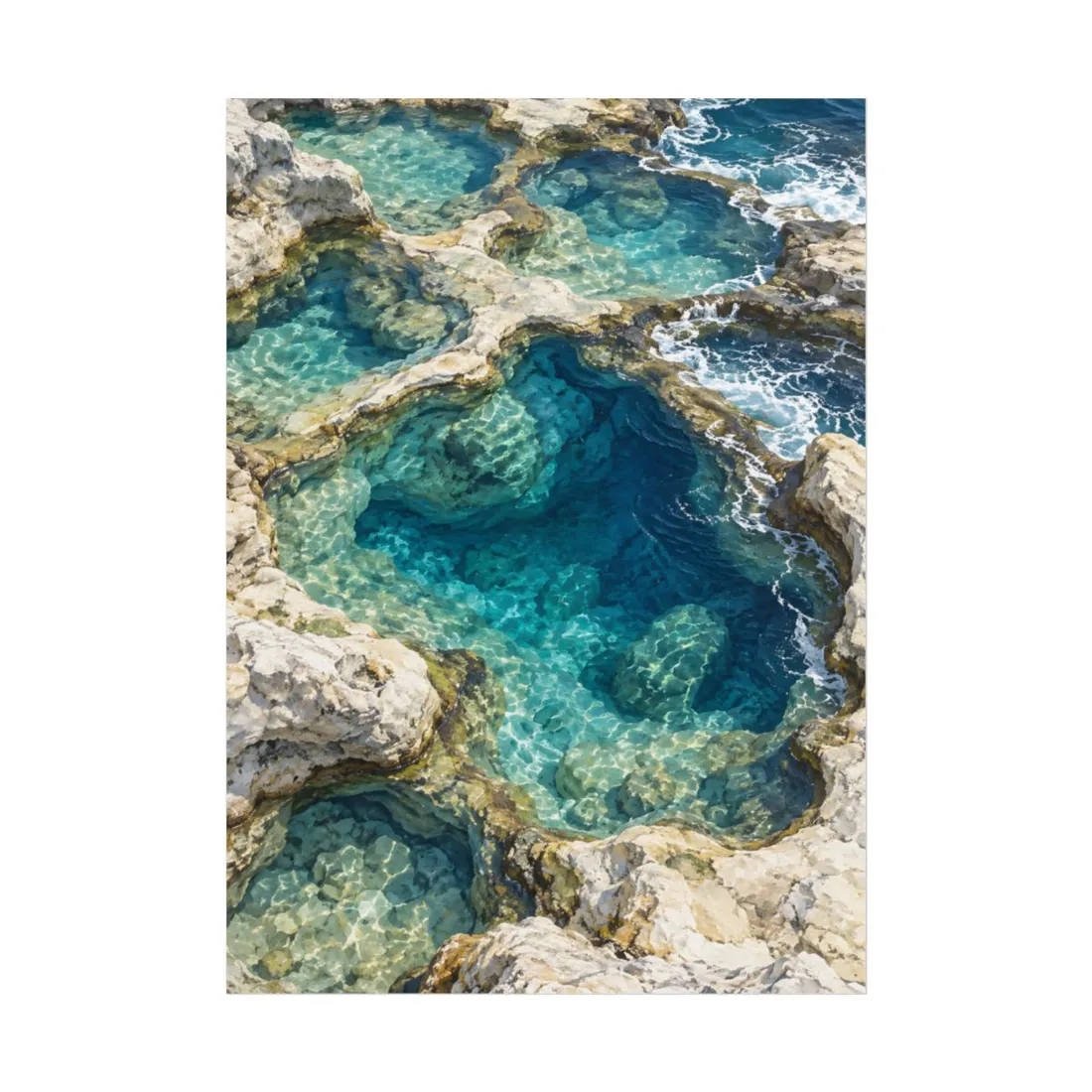
The centre piece below, the Tidal Blue Poster, is stocked at 12 × 18 in. The two side pieces in this example — the Luminous Forest Poster and the Orbital Gateway Poster — come from an entirely different product line: a foggy forest scene and a space scene next to a blue-toned centre piece. That’s deliberate. This is a flexible, mix-and-match sizing example, not a matching bundle, the same way the gallery wall guide combines unrelated motifs by size rather than by palette.
Worked example B: a 45 cm nightstand
A narrower 45 cm (17.7 in) nightstand gives an ideal width of 27-34 cm (10.6-13.4 in): 45 × 0.60 = 27 cm, 45 × 0.75 = 33.75 cm, rounded to 34 cm. The closest commonly available vertical size in this catalogue is 9 × 11 in (22.86 × 27.94 cm) — 22.86 ÷ 45 = 50.8%, under the ideal range.
That’s a genuine gap, and it’s worth stating plainly rather than rounding it away: 50.8% is below the 60-75% target. On a surface this small, it isn’t worth chasing further — a nightstand piece works as an accent, not the room’s focal point, and a slightly undersized print still reads as a deliberate choice rather than a mistake. This is exactly the situation where the 60-75% convention is a guideline rather than a requirement: it describes what looks proportionate against a wall-sized reference, and a nightstand isn’t one. The Luminous Forest Poster used as a side piece above is also stocked in this smaller size — check its product page for current sizes.
If your bedroom does have one genuinely open wall
Not every small bedroom is furniture-dominated on every wall. If yours still has a clear run of 150 cm (59 in) or more, treat it as an open-wall placement rather than a furniture-relative one: the shop’s canvas prints go up to 36 × 24 in for walls that size, and the full size-to-wall-width table — covering wider rooms than this guide — is in the poster sizes guide. That guide’s math isn’t repeated here; the 60-75% convention is the same one, just applied to the wall instead of a 90 cm or 45 cm piece of furniture.
Frequently asked questions
What’s the best poster size for a small bedroom?
It depends on what the poster hangs above, not the room size alone. Size it to 60-75% of the width of the desk, dresser or nightstand beneath it — the same convention used for any furniture-relative placement. The worked examples above show this for both a 90 cm desk and a 45 cm nightstand, with the exact centimetres for each.
Should I buy one bigger poster or group several small ones?
In a small room, grouping smaller sizes usually fits better than hunting for one oversized piece, especially since this catalogue’s largest common poster size is 12 × 18 in (30.48 × 45.72 cm) before moving to canvas.
What if the closest available size is smaller than the 60-75% target?
That’s normal for small furniture like a nightstand. The 60-75% convention is a guideline, not a rule, and a slightly undersized accent piece on a small surface still looks intentional.
What should I do if my bedroom has one large open wall?
Use the shop’s canvas prints, which go up to 36 × 24 in, and the general poster size guide instead of the small-furniture approach described here, since a genuinely open run of 150 cm or more behaves like any standard wall rather than like the furniture-relative cases above.
For other furniture widths and room sizes, see the full table in the poster sizes guide, the vertical-centring method in more detail in the small gallery wall layout guide, or browse the rest of the series at the guides hub.
An AI-assisted buying guide from benotable Art. Featured artworks are AI-generated; check each product page for current sizes and finishes.